
ICAO Q Codes – Universal Language of Aviation Communication
Introduction to ICAO Q Codes
In aviation, an unambiguous an clear communication is very critical for safe and efficient operations. Pilots, air traffic controllers, meteorological stations, and navigation services must exchange information accurately, across different countries and languages.
To take care of this challenge, ICAO the standardization body for aviation adopted standardized set of abbreviations known as Q Codes. Q codes are three-letter codes starting with the letter Q used in radio communication. They provide a succinct and accurate to communicate, initially by way of morse code but continued to be used in the voice transmissions. The codes QAA–QNZ are assigned by the ICAO; QOA–QQZ by the Maritime Mobile Service and QRA–QUZ by the ITU.
Q Codes were initially developed for radiotelegraph i.e. Morse code communications in the 1900s, and later incorporated into aviation and continue to play an important role in modern air navigation and air traffic management.
Why Are They Called Q Codes?
The term “Q Code” comes with the fact that every code in the system begins with the letter Q. During the initial days of wireless communication, operators needed a standardized shorthand that could be transmitted quickly using Morse code. The letter “Q” was selected because it was not commonly used at the beginning of ordinary words in many languages, reducing the confusion during transmission. Each three-letter code represented a complete question or a statement. Followings are few example:
- QNH – What is the atmospheric pressure adjusted to mean sea level?
- QFE – What is the pressure at the airfield elevation?
- QDM – What magnetic heading should I fly to reach a station?
This standardized coding system allowed operators from different countries to exchange information without language barriers.
Why Do We Need Q Codes?
Today, although most of the aviation communication primarily uses plain English phraseology, but still Q Codes continue to provide several important benefits.
- Standardization: Pilot and air traffic control around the world use the same terminology, ensuring consistency regardless of location.
- Reduced Communication Time: A three-letter code can replace a lengthy explanation, making communication faster and more efficient. For example: Instead of saying: “Set your altimeter to the atmospheric pressure corrected to mean sea level.” A controllers simply provide: “QNH 1013.”
- Language Barriers Elimination: Aviation is an international industry. Q Codes provide a universally recognized method of communication that can be understood across different languages and regions.
- Improved Safety: Misunderstandings in aviation can have serious consequences. Standardized codes reduce ambiguity and ensure that critical information is interpreted correctly.
- Legacy and Compatibility: Many aviation procedures, navigation aids, training manuals, and operational documents still reference Q Codes. Maintaining their use ensures compatibility across modern and legacy systems.
Categories of Q Codes
Over the years, hundreds of Q Codes were developed for various communication services. In aviation, they can generally be grouped into following several categories.
Altimetry and Pressure Setting Q Codes
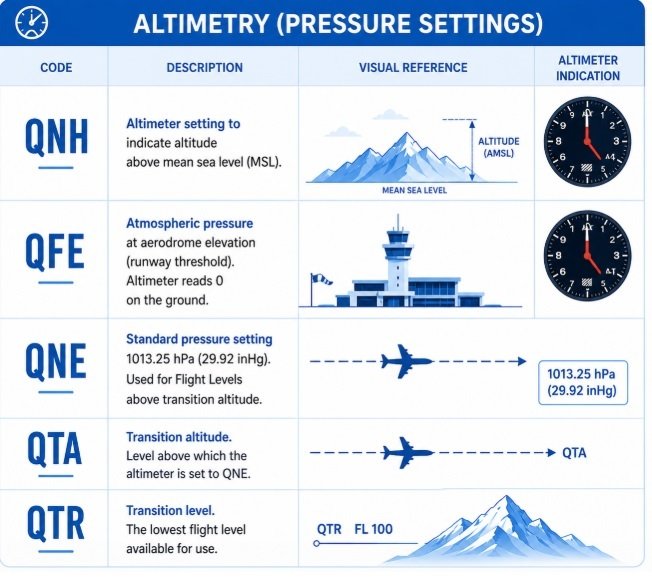
- ONH – Altimeter setting to indicate altitude above mean sea level (MSL)
- QFE – Atmospheric pressure at aerodrome elevation (runway threshold) i.e. altimeter will read 0 on the ground
- QNE – Standard pressure setting 1031.25hPa. Used for flight levels above the transition altitude
- QTA – Transition altitude level above which the altimeter is set to QNE
- QTR – Transition level. The lowest flight level available for use
Radio Navigation Q Codes
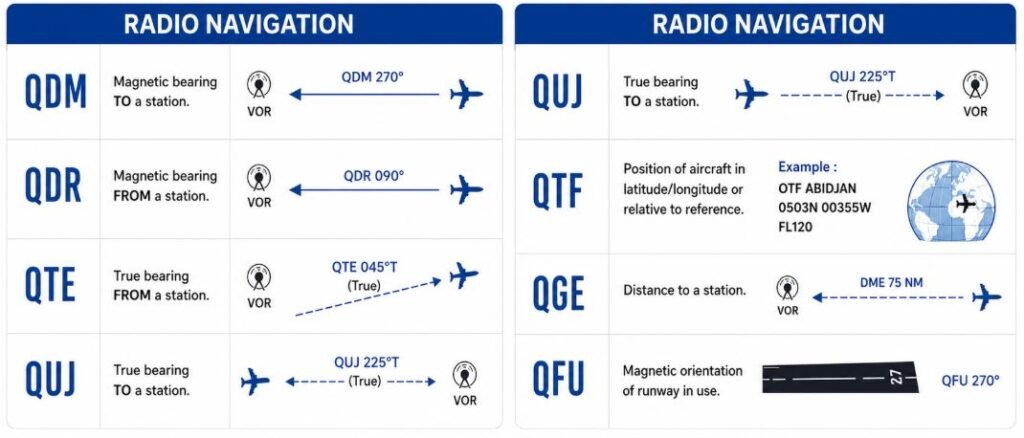
- QDM – Magnetic Bearing To a station
- QDR – Magnetic Bearing From a station
- QTE – True bearing From a station
- QUJ – True bearing to a station
- QGE – Position of a aircraft in longitude/latitude or relative to reference
- QFU – Magnetic orientation of runway in use
- QRA – What is the name of the station?
- QRH – Does my frequency vary?
- QRW – Shall I advice …. that you are calling him ?
- QRF – Are you returning to …. ? I am returning to …. Return to ….
- QRE – What is your estimate time of arrival at …? My ETA at …. is …
- ORV – are you ready ?
- QRX – When will you call me again ? Standby by until …
Weather and Metrological Q Codes
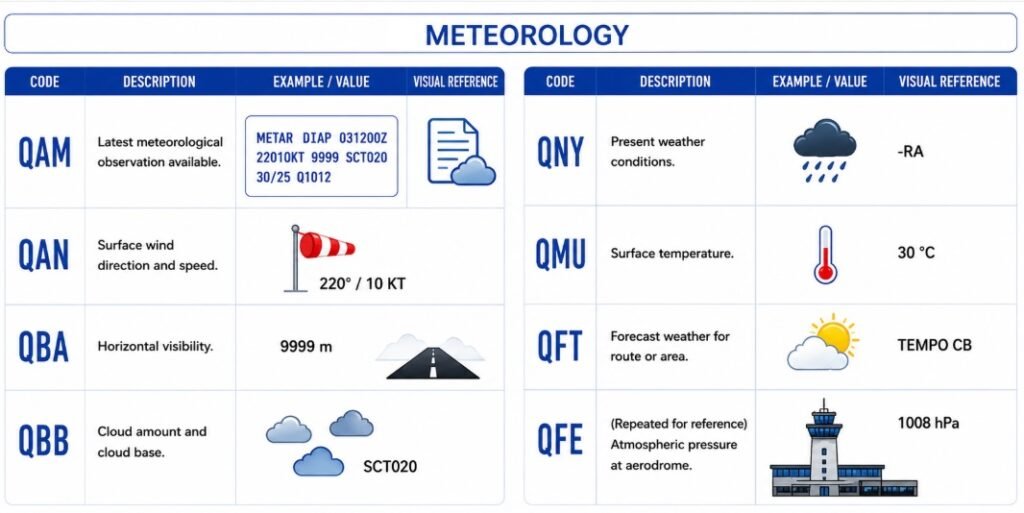
- QAM – Latest metrological observation available. e.g. METAR
- QAN – Surface wind direction and speed
- QBA – Horizontal visibility
- QBB – Cloud amount and cloud base
- QNY – Present weather conditions
- QMU – Surface temperature
- QFT – Forecast weather for the route or area
- QFE – Repeated for reference (Atmospheric pressure at aerodrome)
Air Traffic Control and Flight Operation
- QAI – Essential traffic information concerning an aircraft
- QAK – Is there a risk of collision ?
- QAL – Are you going to land? Is aircraft landed?
- QAU – I am about to jettison fuel
- QAZ – I am flying in storm condition
- QAR – Shall I stop listening on frequency ?
- QAV – Is it safe to land?
- QAS – I am returning to my departure aerodrome
- QGA – Aerodrome/field in sight
Conclusion
ICAO Q Codes represents global communication standardization. Created to simplify wireless communication and overcome language barriers, they continue to serve aviation more than a century now.
From critical altimeter settings such as QNH and QFE to navigation references like QDM and QDR, Q Codes provide a concise, reliable, and internationally recognized method of exchanging operational information. While modern aviation increasingly relies on digital communication systems, Q Codes remain an important part of aviation’s communication heritage and operational procedures.
References
- ICAO Doc 8400 – Procedure for Air Navigation Services (PANS)
- ICAO Doc 4444
- ICAO Abbreviations and Codes
- ICAO Annex 3
- ICAO Annex 10