
Understanding RF connectors: Types, Uses and Applications
Introduction
For a reliable wireless communication system, we as engineers carefully needs to selected RF components, and one of the most critical component among all is an RF connector. Whether it’s a communication base station, Radar System, Satellite Terminal, GPS receiver, or Lab Test equipment, RF connectors make sure that signals are transferred efficiently with minimal loss.
Choosing the right RF connector is much need for maintaining signal integrity, reducing reflections, and ensuring reliability. In this article, Lets explore the most common types of RF connectors, their characteristics and applications.
What is an RF Connector?
An RF connector is an electrical connector which is designed to carry RF signals through coaxial cables, therefore sometimes also called RF Coaxial Connectors. A typical RF plug is made up of a center and outer conductors, as well as insulating materials. These components work together to maintain shielding on coaxial cables.
An RF connector is usually equipped with a spring and a mechanism for fastening it to reduce the insertion force. Both female and male RF connectors are available and widely used for radio broadcasting, TV receivers, communications and radar. They can also be found in medical devices, measuring tools, aerospace and other fields.
Unlike normal electrical connectors, RF connectors are designed to maintain a consistent impedance i.e. typically 50Ω or 75Ω to minimize signal reflections and transmission losses. RF connectors functions includes following:
- Provides a secure electrical connection
- Maintain proper impedance matching
- Minimize signal loss and interference
- Protect against environment (rain, fog, snow etc.)
- Supporting high frequency signal transmission
RF Connector Gender
RF connectors are designed with Standard polarity and reverse polarity, both are available in Male and Female Types.
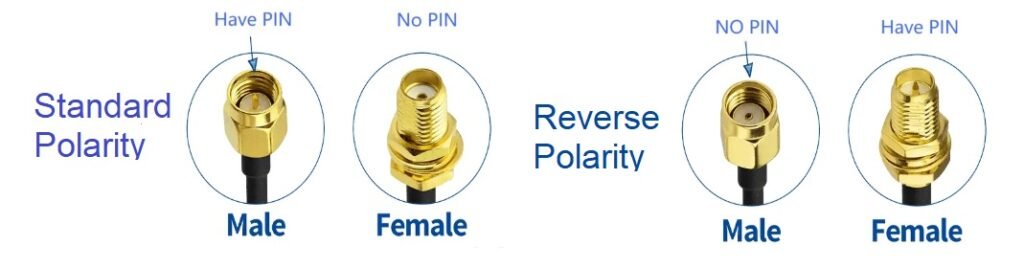
- Standard polarity (SP)
- Male connector for SP, has a pin in the center, while the threads on the housing are located outside.
- Female connector is similar, but has a middle hole to match the male, with the threads being located outside.
- Reverse polarity (RP), RF connectors, the gender configuration is different.
- Male connector for RP, has a thread inside the housing instead of a pin.
- Female connector, on the other hand, has an external thread and a center pin.
There are also sexless connectors. Gender-neutral plugs are mounted flush, rather than mating. These connectors are usually similar in housing and can be paired with any other connector.
Types of RF Connectors
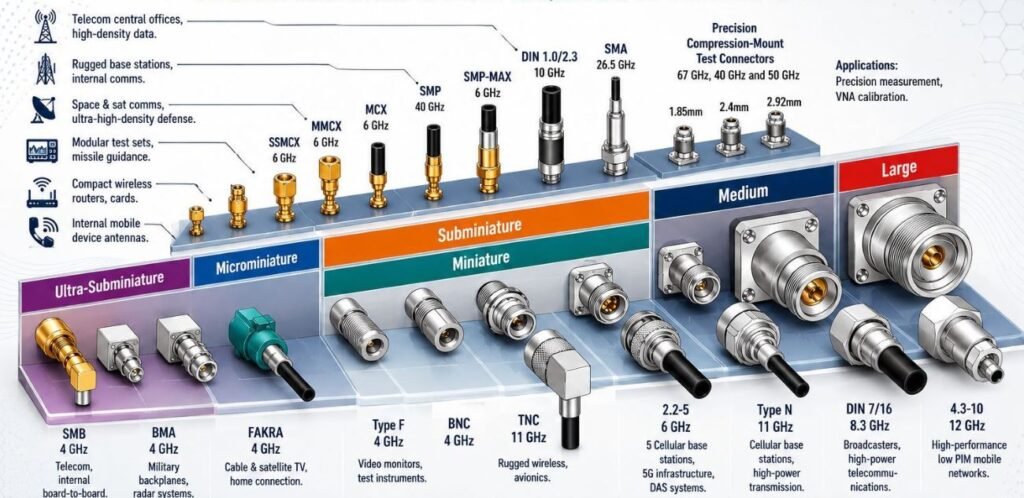
Based on the size of RF connector we can classify them into following categories.
- Ultra-subminiature RF Connectors
- Microminiature RF Connector
- Subminiature and Miniature RF connector
- Medium and Large RF Connector
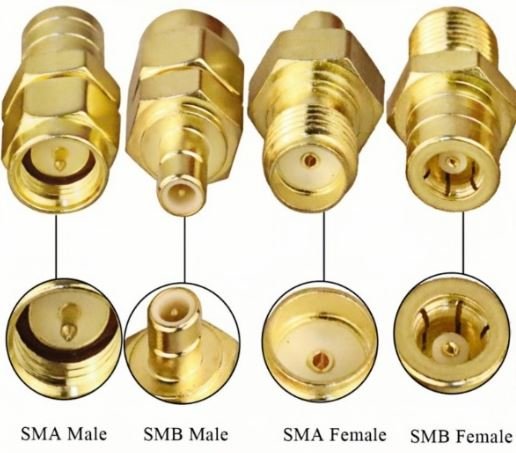
SMA and SMB RF Connector:
Sub miniature RF Connector have different version named as A, B and C better known as SMA, SMB etc. These are a compact RF coaxial connector developed in 1960s. SMB connector is smaller than an SMA connector and features a snap-on coupling mechanism, making it ideal for applications that require quick connection and disconnection.
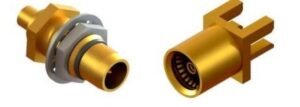
BMA RF Connector
BMA Connectors or Blind-Mate Connectors are slide-on/push-on RF connectors. A connection using these connectors can simply be made by pressing two BMA connectors together (Male & Female). They do not require wrenches or other tools to secure the connection. A type of spring mechanism is used to make the connection which also takes care of small misalignments when mating.
FAKRA RF Connector
Fakra connectors are specialized RF connectors standardized under ISO 20860, widely used in automotive, GPS, and communication systems. Based on the SMB connector interface, Fakra connectors typically operate up to 4 GHz, with some types supporting frequencies up to 6 GHz.
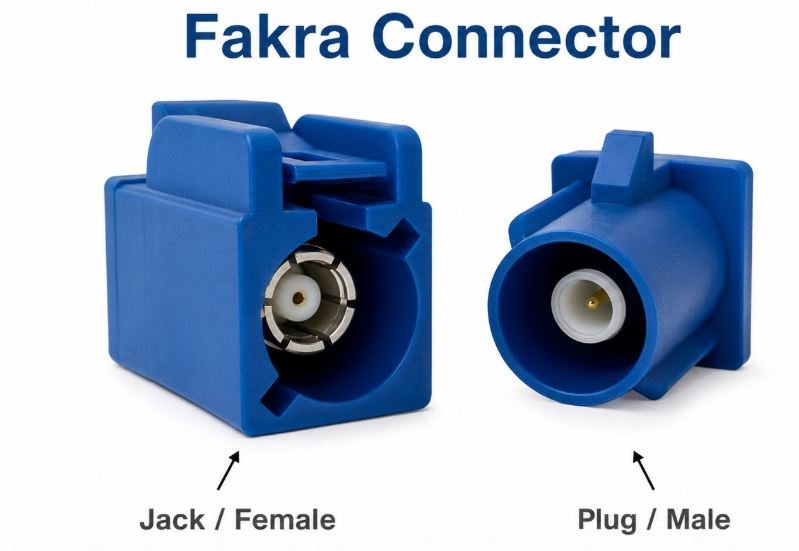
They feature a secure plastic housing with color-coded and keyed designs to prevent mis-mating. The locking mechanism also ensures a secure, vibration-resistant connection.
Type F RF Connector
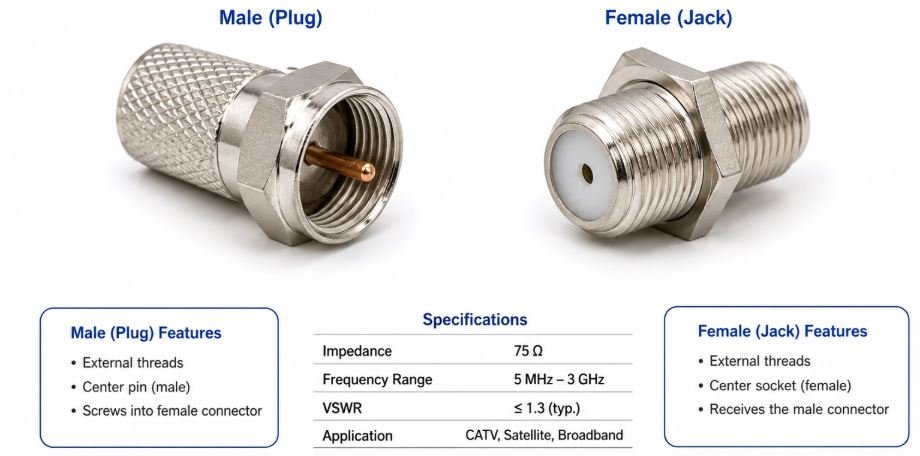
Type F RF Connector is a threaded coaxial RF connector widely used in cable television (CATV), satellite TV, and broadband internet systems. It provides a cost-effective and reliable connection with a characteristic impedance of 75 Ω. Type F connectors are valued for their low signal loss, easy installation, and excellent performance in high-frequency applications.
BNC RF Connector
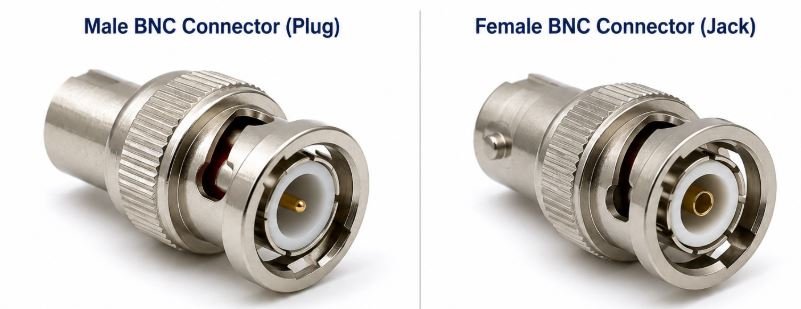
The BNC connector is a miniature quick-connect/disconnect rf connector for coaxial cable. It was introduced on military radio equipment in the 1940s, and has since become widely used in radio systems and as a common type of video connector. It has a twist-to-lock design, where two lugs on the female connector engage slots in the shell of the male one.
TNC RF Connector
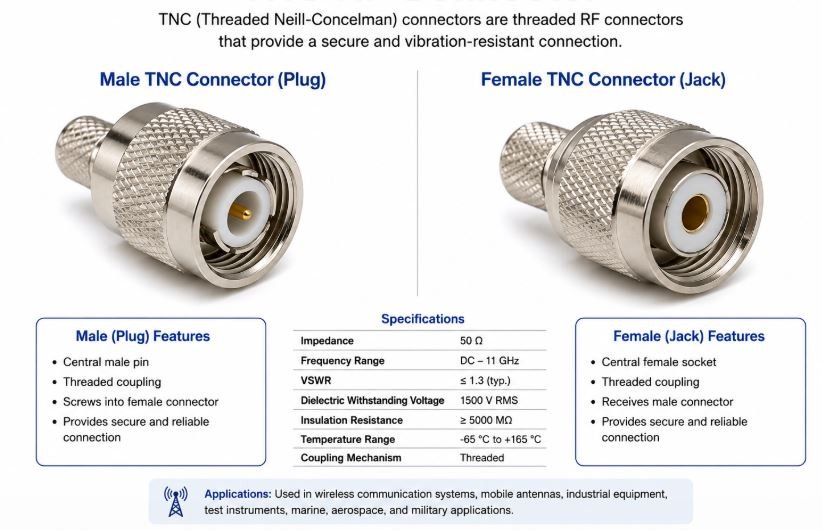
TNC – Threaded Neill-Concelman rf connector is a robust, threaded version of the standard BNC connector. It is primarily used for rf and microwave connections, delivering superior signal integrity and preventing accidental disconnection in high-vibration environments.
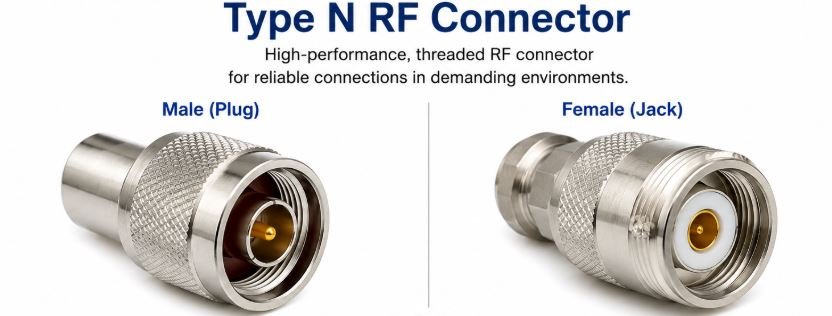
Type N RF Connector
Type N RF Connector is a threaded coaxial RF connector designed for high-power and high-frequency applications, offering excellent performance . It provides low signal loss, weather resistance, and reliable impedance matching, making it suitable for demanding outdoor environments. Type N connectors are widely used in cellular base stations, antennas, microwave links, wireless networks, and RF test equipment.
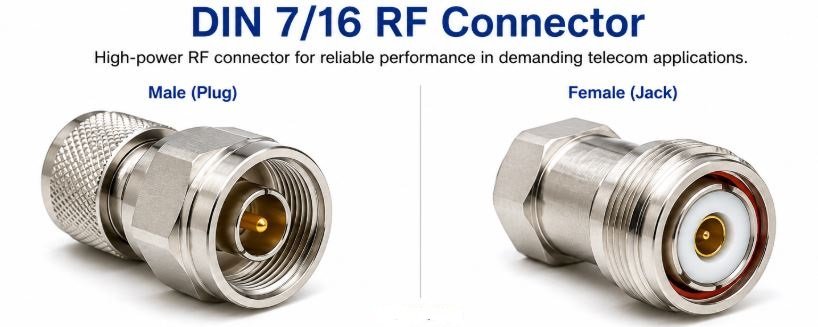
DIN 7/16 RF Connector
DIN 7/16 RF Connector is a high-power threaded coaxial connector designed for demanding RF and telecom applications. It offers excellent electrical performance, low Passive Intermodulation (PIM), and superior weather resistance, making it ideal for outdoor deployments. DIN 7/16 connectors are widely used in cellular base stations, broadcast systems, DAS networks, and high-power antenna installations.
Conclusion
RF connectors appear to be small components, but they play a vital role in the performance and reliability of wireless communication systems. From SMA connectors used in laboratory testing to 4.3-10 and 7/16 DIN connectors powering modern 5G networks, each connector type serves a specific purpose.
Understanding their characteristics, strengths, and limitations enables engineers to select the right connector for every application, ensuring optimal signal transmission and long-term network reliability.