
What is an ANSP – Air Navigation Service Provider?
When we discuss about aviation, usually consider about airlines, pilots, and airports. But there is a more critical organization working silently behind the scenes known as Air Navigation Service Provider- ANSP.
Every aircraft in the air depends on ANSP services from ground movement, takeoff to landing. Without ANSPs, modern aviation could not exist.
Definition – Air Navigation Service Provider- ANSP
By definition, an Air Navigation Service Provider (ANSP) is an organization, responsible for managing and controlling aircraft flying within a country’s airspace to ensure safety, efficiency, and orderly flow of air traffic.
with road transport analogy, it is like the vehicle managements by an authority usually traffic police to implement and enforce the rules and regulation in the city or state to prevent accidents. Similar kind of structured management is required in air space for smooth air traffic movement. ANSP does not operate airplanes and does not manage passengers — it manages the airspace itself.
ANSPs Key Pointers
- ANSP is a public or a private legal entity providing air navigation services
- It is a centralized authority to organize and monitor all flights safely
- Depending on the specific mandate, it manages air traffic on behalf of a region or country or company
- ANSP provides one or more services e.g. Air Traffic Management, Communication, Navigation to airspace users (Airline companies, Public flights, SAR flights).
Why we need ANSPs
Modern airspace is becoming crowded as more and more aircraft are adding and aircraft operate at very high speeds and different altitudes. Pilots cannot visually see other aircraft from long distances, and unlike cars, airplanes cannot stop or quickly change direction to avoid collisions. Therefore, a centralized authority is required to organize and monitor all flights safely — this role is performed by the ANSP.
- ANSPs ensure safe separation between aircraft by continuously tracking their position using radar and other surveillance systems and providing real-time instructions through air traffic controllers.
- ANSPs also design structured air routes, manage takeoff and landing sequences, and prevent congestion through air traffic flow management.
- ANSPs publish critical flight information such as weather hazards as Metrological reports
- ANSPs publishes restricted airspace information, and navigation procedures, which pilots depend on before and during every flight. T
- ANSPs also enable international air traffic by coordinating seamless handovers between countries’ airspaces.
In summary, ANSPs provide safety, efficiency, and predictability in global aviation. They make it possible for thousands of aircraft to fly simultaneously across the world every day without accidents.
Who Govern and Oversees of ANSPs
Governance and oversight of ANSPs are is not the same in every country. In some, ANSPs operate as government organizations, while in other countries work as independent or private non-profit entities.
For example,
- In the United States, air navigation services are operated by the Federal Aviation Administration (FAA), a government body.
- In Canada, NAV CANADA operates as a private, non-profit corporation.
As per international standards defined for aviation by ICAO, a clear governance structure improves ANSP performance because it defines responsibilities clearly, improves accountability and ensures transparent service charges for safe and efficient air traffic management.
Core Section or Functions of ANSPs
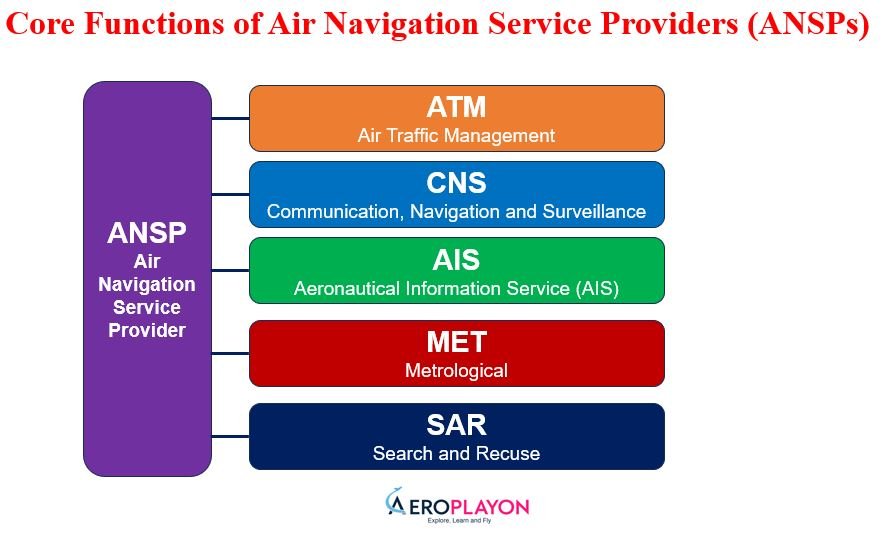
As shown in following figure, there are major following five core section or functions of ANSPs.
- Air Traffic Management – ATM
- Communication, Navigation and Surveillance – CNS
- Aeronautical Information Service – AIS
- Metrological Division – MET
- Search and Recuse – SAR
Air Traffic Management – ATM
ATM in includes all systems that assist aircraft to depart from an aerodrome, transit airspace, and land at a destination aerodrome (Sections of a Flight) including Air Traffic Services (ATS), Airspace Management (ASM), and Air Traffic Flow and Capacity Management (ATFCM). These all services are provided by Air Traffic Controllers (ATCOs) to guide aircraft during all phases of flight i.e. Pushback & taxi, Takeoff, Climb, en-route cruise, Descent, Approach and Landing. Controllers maintain safe separation between aircraft both horizontally and vertically.
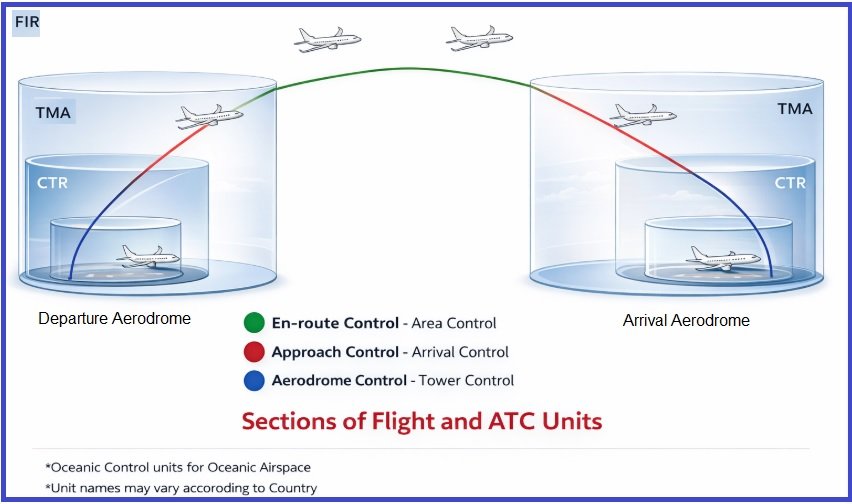
ATC is divided into three main units:
- Tower Control – manages airport surface and takeoff/landing
- Approach Control – handles aircraft near airports
- Area Control Center (ACC) – manages aircraft at cruising altitude
Communication, Navigation and Surveillance – CNS
ANSPs technical wing which operates and manage complex technical infrastructure known as Communication, Navigation and Surveillance – CNS. This service function with in ANSP acts as the “eyes and ears” of air traffic control. CNS function consist of following three sub functions.
- Communication: In aviation communication, refers to radio communication between two or more aircraft, or the exchange of data or verbal information between aircraft and air traffic control unit. For continental airspace, VHF (civil) and UHF (military) systems are used whereas for oceanic areas, high frequency (HF) systems and Satellite Communication (SATCOMs) are used.
- Navigation: Air navigation, refers to the process of planning, recording, and controlling the movement of an aircraft from one place to another by providing accurate, reliable and seamless position determination capability. It enables aircrafts to determine position and follow routes with the help of VOR/DME stations, Instrument Landing System (ILS) and Satellite navigation (GNSS/GPS).
- Surveillance: Surveillance systems are used for air traffic control to see aircraft in real time and determine the position. It uses Primary radar, Secondary surveillance radar, ADS-B tracking and Multilateration systems
Aeronautical Information Service – AIS
Aeronautical Information Service (AIS) is a service for Aeronautical Information Management (AIM). It is established to ensure the flow of information e.g. flight plan, NOTAMs necessary for the safety, regularity, and efficiency of international air navigation. With AIS/AIM ANSPs publishes critical aviation data like Aeronautical charts, Airport procedures, Flight routes, NOTAMs (Notices to Airmen), Weather hazards and Restricted airspace alerts. Before every flight, pilots review AIS data during pre-flight briefing.
Metrological Division – MET
Aviation Meteorology (MET) studies weather conditions as they can affect aircraft operations. Its primary goal is to support safe, efficient, and economical flight by providing accurate forecasts and real-time weather information as METAR to pilots and air traffic control. It helps prevent hazards such as turbulence, thunderstorms, icing, and low visibility, ensuring smoother flight planning and safer navigation.
Search and Recuse – SAR
In aviation, Search and Rescue (SAR) means a coordinated effort to locate and assist aircraft, crew, or passengers in distress condition. ANSPs play an important role by alerting rescue agencies, sharing last known location of aircraft, and maintaining communication support.
SAR operations may involve aircraft, helicopters, ships, and ground teams depending on location and . The objective is to provide rapid assistance and improve survival chances after an emergency or accident.
Further Reading
To understand Air Navigation Service Providers (ANSP) and global air traffic management standards in more depth, refer to the official aviation authorities below:
- ICAO – Air Navigation Services
- ICAO Annex 11 – Air Traffic Services Overview
- ICAO Global Air Navigation Plan (GANP)
- FAA Air Traffic Organization
- EUROCONTROL – Air Traffic Management
- Airports Authority of India – Air Navigation Services
- CANSO (Civil Air Navigation Services Organization)
- IATA Air Traffic Management
- SKYbrary Aviation Safety Knowledge Base
- NAV CANADA – ANSP Operating Model
Related Post: