
What is a NOTAM – Notice to Airman
Across globe, thousands of airplane take off and land safely around the world everyday. But before any pilot takes the seat and starts an engine, he must read a set of critical safety messages knows as Notice to Air – NOTAM.

NOTAM messages provides information about close of particular country air space, closure of a runway, warning about military activity, report about GPS failure, or even announce a crane near an airport. In aviation, NOTAM ignorance is illegal and can be fatal dangerous.
Definition of NOTAM
A NOTAM (Notice to Airmen or Notice to Air Missions) is a notice or message containing essential information to personnel concerned with flight operations. The important information it contains about aeronautical facilities, services, procedures, or hazards. The timely knowledge of this information is crucial for personnel involved in flight operations.
Why NOTAMs are Required ?
Personal who are involved with Flight operation refers Aeronautical Information Publications (AIP) and charts while planning a flight route. AIPs and charts information are updated every 28 days, but aviation is very dynamic and changes every hour. So we need a faster way to communicate these dynamic change to airmen (Pilots, Flight Dispatchers etc.) so NOTAMs are introduced. NOTAM acts like real-time WhatsApp messages of aviation safety.
Without NOTAM:
- Aircraft may land on closed runways
- Pilots may enter restricted military airspace
- Navigation systems such as ILS, DOVR may fail unexpectedly
- Construction cranes may collide with aircraft
NOTOM Key Pointers
- NOTAMs have a unique language characterized by the use of specialized contractions or we can say a shorter forms of words.
- This Contractions are imperative to the NOTAM structure to make communication more efficient and allow computer systems to parse important words.
- Timeliness and Conciseness: NOTAM messages use short standardized codes so pilots can understand important hazards quickly without reading long explanations. This helps them make fast decisions and avoid danger.
- Reliable Information: NOTAMs are sent using the fastest communication systems so pilots receive them on time. They are available during pre-flight briefings at airports and also through airline or company briefing systems.
- NOTAM internationally via the Aeronautical Fixed Telecommunication Network (AFTN)
- ANSPs issues NOTAM in their airspace/country/Flight Information Region (FIR)
- ICAO is the leading authority for standardizing contractions in the international aeronautical community.
- When, If there is no ICAO contraction, plain language is used
- Modern SWIM/Digital NOTAM systems, allowing pilots worldwide to receive safety updates before flight
Building Blocks of a NOTAM
All NOTAMs follow a specific format, which includes several required elements.
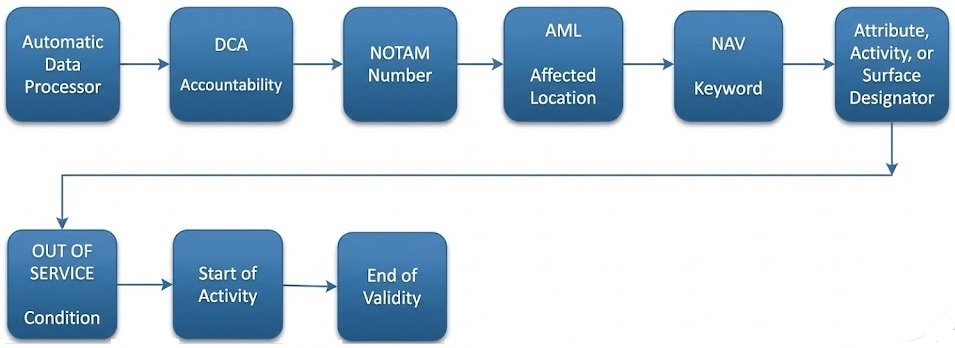
- Automatic Data Processor (!) : Indicates the message is an automatically generated NOTAM.
- DCA Accountability: Identifies the issuing or responsible NOTAM office/location.
- NOTAM Number: Unique serial identification of the NOTAM for tracking and reference.
- AML Affected Location: Specifies the airport, airspace, or navigation facility impacted.
- NAV Keyword: Defines the subject or hazard (runway, taxiway, navaid, obstacle, etc.).
- Attribute / Activity / Surface Designator: Provides specific details about the affected element.
- OUT OF SERVICE Condition: States the operational status or restriction of the facility.
- Start of Activity: Time when the condition becomes effective (UTC).
- End of Validity: Time when the condition ceases or expires (UTC).
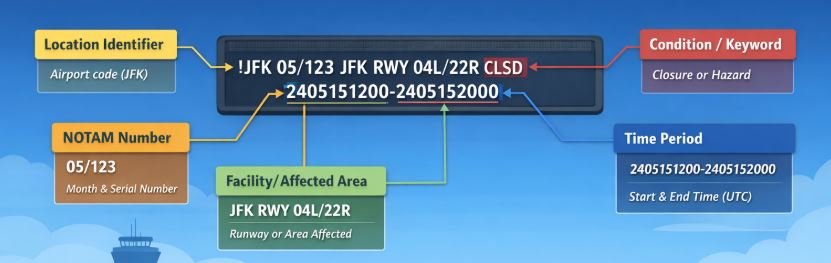
Example of NOTAM is shown in following picture.
FAA NOTAM Categories
Understanding the different types of NOTAMs is vital for effective pre-flight planning. These classifications include:
- Class I NOTAMs:
- Telecommunication Distribution: These NOTAMs are communicated via telecommunication processes. They typically contain important, timely information about the flight route or destination.
- Class II NOTAMs
- Published NOTAMs: These are distributed by means other than telecommunications. In the United States, they are published in the Notices to Airmen Publication (NTAP), or Aeronautical Information Publications (AIP), which is issued every 28 days.
- International NOTAMs
- Cross-National Distribution: These NOTAMs are intended for distribution to more than one country. They include information relevant to multiple nations and are stored in the United States NOTAM System (USNS) or published in the International NOTAM section of the NTAP.
- Military NOTAMs
- Military-Specific: These NOTAMs are part of the military NOTAM system and primarily include information about military airports and airspace. They rarely apply to civilian activities, flights, or operations unless the airfield is used for civilian purpose..
- FDC NOTAMs (Flight Data Center NOTAMs)
- Regulatory Updates: These NOTAMs contain regulatory updates such as changes to instrument approach procedures, airway alterations, or Temporary Flight Restrictions (TFRs). They are crucial for maintaining compliance with safety regulations.
ICAO NOTAM Types
- NOTAM Types as per Status
- NOTAMN — New: NOTAM N is issued when a situation is reported for the first time and immediately affects flight operations. Used for: Newly discovered obstacle, Sudden runway damage, Navigation aid failure, Emergency airspace restriction. Its purpose is to alert pilots to new hazards that are not published anywhere else.
- NOTAMR — Replacement: NOTAM R, replaces an existing NOTAM completely. After this, previous NOTAM becomes invalid automatically. It is used validity time changes, Coordinates corrected, Additional operational detail added. It is very important for Pilots must read the replacement fully — information may change significantly.
- NOTAMC — Cancellation: NOTAM C Cancels an earlier NOTAM because the condition no longer exists. It is used in cases: Maintenance finished, Equipment facility is restored, Airspace is reopened operation.
- NOTAM Types as per Operational Importance
- NOTAM D – Distance NOTAM: The most common NOTAM type — distributed widely. Contains: Runway closure, Taxiway restriction, Lighting failure, Fuel unavailable, Bird hazard, ILS or VOR unserviceable. It may affects Flight planning, dispatch, ATC clearance, etc..
- NOTAM L – Local NOTAM: Limited distribution — mainly within the airport area. Examples: Apron work, Parking stand restriction, Minor taxi route change These are used for Domestic or locally briefed pilots.
- NOTAM Types as per Subject Category
- Aerodrome NOTAM are related to airport infrastructure changes which includes runway closed or shortened due to repair, Taxiway blocked, snow/contamination, braking action reports
- CNS NOTAM are about communication, navigation or surveillance equipment’s unavailability unserviceability. These includes DVOR/DME failure, ILS/Glide slope unusable, Radar outage or Communication frequency change.
- Airspace NOTAM: Airspace structure or restriction changes. Includes: Temporary Restricted Area (TRA) Prohibited area activation VIP movement airspace closure
- Obstacle NOTAM: Temporary hazards near flight path. Includes: Cranes Towers Balloons Construction equipment
- Military / Hazard NOTAM: Dangerous activities in airspace. Includes: Missile firing Artillery practice, UAV operations, Rocket launches
- GNSS / GPS NOTAM: Satellite navigation reliability warnings. Very important in modern aviation Includes: GPS interference testing, Jamming exercises, Solar storm impact
Practical Examples
To understand the importance of NOTAMs, consider these practical examples:
- Closed Runways/Taxiways: If a runway is closed due to maintenance, a NOTAM will alert pilots about the closure and the availability of alternative runways.
Unserviceable Radio Navigational Aids: If a critical navigation aid is out of service, a NOTAM will inform pilots so they can adjust their navigation strategy accordingly. - Airspace Restrictions: Military exercises or airshows can restrict airspace; NOTAMs ensure that pilots are aware of these restrictions before entering the affected area.
Example NOTAM for Denver International Airport (DEN/KDEN)
KDEN 10/325 DEN RWY 08/26 CLSD 2200-0600 DLY WEF 20251015-20251022
Explanation:
- Location Identifier: KDEN indicates that this NOTAM is for Denver International Airport.
- Series Number: 10/325 is the unique serial number for this NOTAM, issued in October.
- Subject: DEN RWY 08/26 CLSD specifies the closure of Runway 08/26.
- Time and Date: 2200-0600 DLY indicates that the runway will be closed daily between 10:00 PM and 6:00 AM local time.
- Duration: WEF 20251015-20251022 specifies the effective timeframe of the closure from October 15, 20235 to October 22, 2025.
Breakdown of Key Elements:
- KDEN: The K followed by the three-letter airport code DEN denotes that the NOTAM is for Denver International Airport.
- 10/325: 10 signifies the month (October) and 325 is the sequential issuance number of the NOTAM within that month.
- DEN RWY 08/26 CLSD: Indicates that Runway 08/26 at Denver International Airport is closed.
- 2200-0600 DLY: Denotes the specific times (from 9:00 PM to 5:00 AM local time) when the runway will be closed daily.
- WEF 20251015-20251022: Indicates the effective period (“With Effect From”) from October 15, 2023, to October 22, 2023.
Practical Impact to Airmen
- Ground Services: Airport ground services must coordinate activities considering the runway closure to avoid any operational disruptions.
- Pilots: Pilots planning to land or take off at Denver International Airport during these times need to be aware of the runway closure and plan accordingly.
- Flight Operations: Airlines and flight operators must take this closure into account when scheduling flights and ensuring alternative arrangements are made.
Conclusion
NOTAMs are an integral part of aviation real-time safety alert system, providing critical information that pilots need to operate safely. Understanding the different types and sources of NOTAMs is essential for effective pre-flight planning. By staying informed about these notices, pilots can avoid hazards and ensure smooth, safe flights, prevent incidents and improves operational efficiency.
Whether you’re just starting out or are a seasoned aviation professional, recognizing the importance of NOTAMs will enhance your flying experience and safety protocols. Without NOTAM, safe and coordinated global air travel would not be possible.
References
- NOTAM Search: https://notams.aim.faa.gov/notamSearch/
- National Flight Data Center Homepage: https://nfdc.faa.gov/xwiki/bin/view/NFDC/WebHome
- Flight Service Homepage: www.faa.gov/go/flightservice
- Flight Service Flight Briefing Website: www.1800wxbrief.com
- Current Temporary Flight Restrictions: http://tfr.faa.gov
- Flight Service ENII System: https://notams.aim.faa.gov/en2/
- GPS Notices: https://www.faasafety.gov/SPANS/notices_public.aspx
- OEAAA Portal: https://oeaaa.faa.gov/oeaaa/external/portal.jsp