
Aviation Frequency Spectrum: The Backbone of Flight Safety
In the world of aviation, “seeing” is often secondary to “hearing.” While a pilot’s eyes are on the horizon, the safety of the flight relies entirely on an invisible, crowded, and highly regulated resource: the Electromagnetic Frequency Spectrum.
Aviation fully depends on radio frequency spectrum as critically as it depends on runways and aircraft. Every voice instruction from Air Traffic Control (ATC), every radar return, every navigation signal guiding an aircraft, and every satellite-based surveillance update relies on carefully protected and internationally harmonized spectrum bands.
Unlike commercial telecom systems where a dropped call is a minor inconvenience, aviation spectrum is:
- Safety-of-Life critical
- Globally standardized
- Highly interference-sensitive
Any disruption or interference can directly impact flight safety, making spectrum management a cornerstone of global aviation operations.
What Is Aviation Frequency Spectrum?
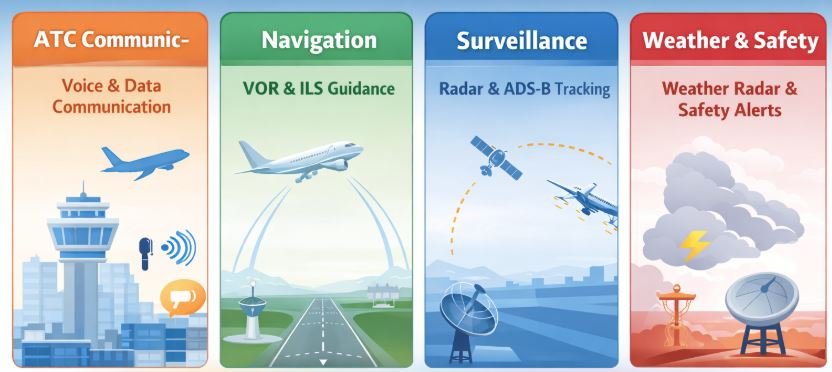
Aviation spectrum refers to specific radio frequency bands allocated internationally for aeronautical services under the ITU Radio Regulations. These frequencies support following services:
- Communication (Voice & Data)
- Navigation
- Surveillance
- Weather and safety systems
These bands are protected, regulated, and coordinated globally to ensure interoperability across countries and airspaces.
International Regulation and Governance
The global aviation ecosystem depends on harmonized spectrum regulation to ensure seamless, safe, and interference-free operations across national boundaries. Because aircraft routinely cross international airspace, aviation spectrum cannot be managed in isolation by individual countries. Instead, it is governed through a multi-layered international regulatory framework led by global and national institutions. At global level it includes organization like The International Telecommunication Union (ITU) and The International Civil Aviation Organization (ICAO) etc.
International Telecommunication Union (ITU) Role
The International Telecommunication Union (ITU) is the United Nations specialized agency responsible for global spectrum management. It provides the legal and technical foundation for aviation spectrum usage worldwide. Key responsibilities of ITU include:
- Allocating radio frequency bands to aeronautical services
- Publishing the ITU Radio Regulations, an international treaty
- Defining aeronautical services such as:
- Aeronautical Mobile (Route) Service (AM(R)S)
- Aeronautical Radio Navigation Service (ARNS)
- Aeronautical Mobile-Satellite Service (AMSS)
- Ensuring protection of aviation spectrum from harmful interference
World Radiocommunication Conference (WRC)
Every 3–4 years, ITU organizes the World Radiocommunication Conference (WRC), where:
- Global spectrum allocations are reviewed
- New aviation spectrum requirements are addressed
- Coexistence between aviation and emerging technologies (e.g., 5G, satellite broadband) is negotiated
Decisions made at WRC directly influence the future availability and protection of aviation spectrum worldwide.
Role of the International Civil Aviation Organization (ICAO)
The International Civil Aviation Organization (ICAO) focuses on the operational use of aviation spectrum, ensuring that radio systems support safe and efficient air navigation. ICAO’s key contributions include:
- Defining aviation communication, navigation, and surveillance (CNS) standards
- Publishing technical requirements in ICAO Annex 10 – Aeronautical Telecommunications
- Ensuring global interoperability of aircraft and ground systems
- Coordinating spectrum protection requirements with ITU
While ITU determines which frequencies are allocated, ICAO defines how those frequencies are used in aviation operations.
National Spectrum and Aviation Authorities
Each country implements aviation spectrum regulations through national civil aviation authorities and spectrum regulators, in alignment with ITU and ICAO frameworks. National authorities are responsible for Licensing aeronautical radio stations, Managing frequency assignments at airports, Monitoring and mitigating interference and Coordinating civil and military spectrum use. Examples of some national authorities include:
- FAA & FCC – United States
- EASA & CEPT – Europe
- CAAC – China
- AAI & WPC – India
- CASA & ACMA) – Australia
Key Aviation Frequency Spectrum and Their Applications
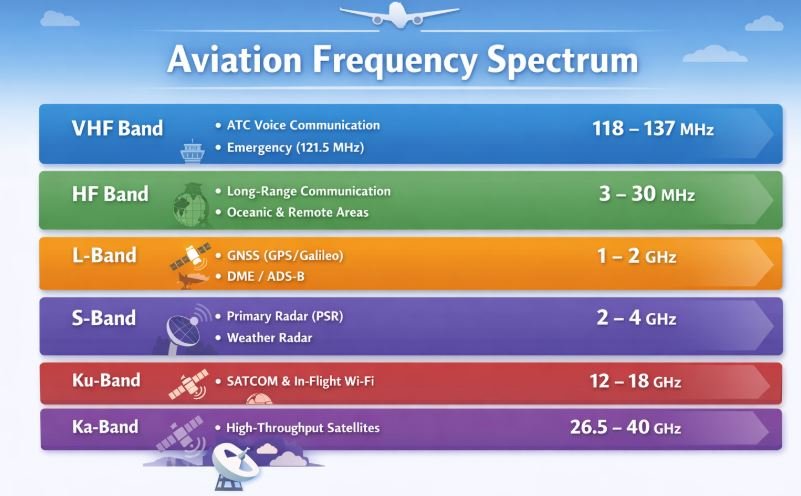
Dedicated frequency bands are used for aeronautical communication, navigation, and surveillance. These include VHF and HF bands for ATC voice and data communications, L-band frequencies for navigation systems such as GNSS, DME, and surveillance systems like SSR and ADS-B, and higher bands for satellite communications. Each spectrum band is internationally harmonized and strictly protected to ensure safety-of-life aviation operations without harmful interference.
Aeronautical Mobile (Route) Service – AM(R)S
Aeronautical Mobile (Route) Service – AM(R)S is a safety-critical radio service used for communications between aircraft and ground stations during en-route and terminal phases of flight. It supports required air traffic control voice and data communications, ensuring safe, orderly, and efficient aircraft operations. AM(R)S operates in internationally protected spectrum allocated under ITU Radio Regulations and governed operationally by ICAO standards.
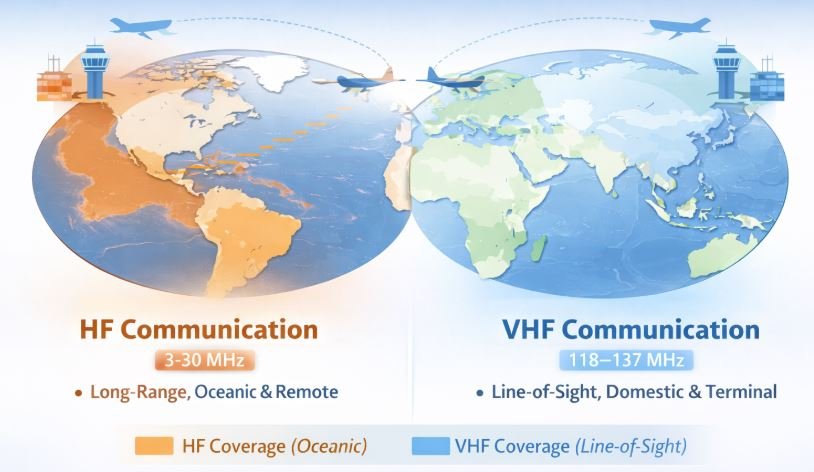
- HF Communication (3 – 30 MHz): HF frequency range 3-30 MHz is used to enable communication in oceanic, polar, and remote regions where VHF coverage and ground infrastructure are unavailable. It supports long-range voice communication and data services, including Controller–Pilot Data Link Communications (CPDLC) over HF, ensuring continuous ATC connectivity on long-haul routes. The key pointer of HF communication includes
- Ability to operate beyond line-of-sight by reflecting radio waves off the ionosphere, allowing signals to travel thousands of kilometers making it suitable for Oceanic and remote area communications.
- HF communication are highly susceptible to atmospheric noise, solar activity, and ionospheric disturbances, affecting signal quality, reliability, and availability.
- VHF Band (118–137 MHz): It is the primary and most widely used frequency range for air traffic control (ATC) voice communication and routine pilot–controller communications in civil aviation.
- Used for:
- ATC voice communication
- Pilot–controller communication
- Emergency frequency (121.5 MHz)
- Characteristics:
• Line-of-sight ability maks it highly reliable and well-suited for terminal and en-route operations within controlled airspace
• High reliability provide clear voice and low interference
- Used for:
Aeronautical Navigation Spectrum
The Aeronautical Navigation Spectrum consists of dedicated frequencies that support critical navigation systems such as VOR, ILS, DME, and GNSS, guiding aircraft safely during all phases of flight. These low-power signals are highly protected to ensure precision, reliability, and interference-free operation, enabling accurate en-route navigation, approach, and landing worldwide. It includes following frequency for navigation instruments.
- VOR (108–117.975 MHz): VHF omni range provides aircraft azimuth information for navigation.
- ILS Localizer (108–112 MHz): Guides aircraft toward the runway centerline during approach.
- ILS Glide Path (329–335 MHz): Provides vertical descent guidance/glide angle for precise landing.
- DME (960–1215 MHz): Measures slant range distance between aircraft and ground station for navigation.
- GNSS (L-band ~1.1–1.6 GHz): Offers global satellite-based positioning, navigation, and timing for aviation.
Air Surveillance Spectrum
The Surveillance Spectrum is essential for monitoring and tracking aircraft to ensure safe and efficient air traffic management. In surveillance includes Primary Surveillance Radar (PSR), Secondary and Surveillance Radar (SSR)
- Primary Surveillance Radar (PSR) operating typically in the L-band (1-2GHz) or S-band (2-5GHz) , detects aircraft independently of onboard equipment by reflecting radar signals off the aircraft’s surface.
- Secondary Surveillance Radar (SSR) relies on aircraft transponders, with 1030 MHz used for interrogation and 1090 MHz for replies, supporting systems like Mode A/C, Mode S, and ADS-B (1090ES).
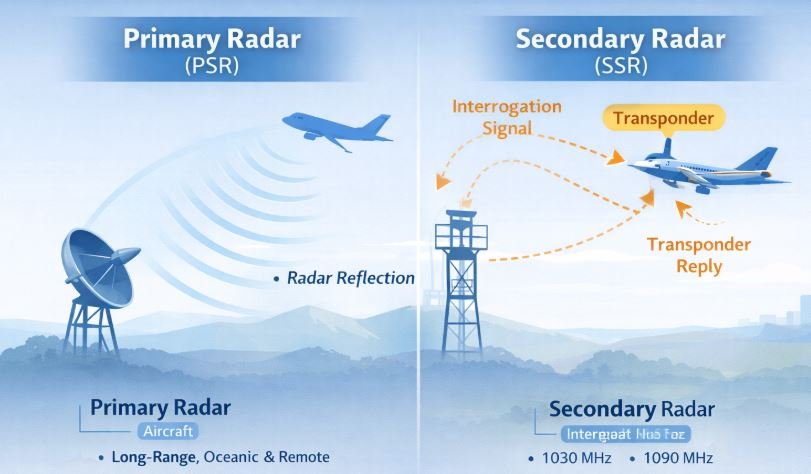
PSR and SSR provide comprehensive situational awareness, combining passive detection and active aircraft identification for both civil and military air traffic control.
Satellite-Based Aviation Spectrum
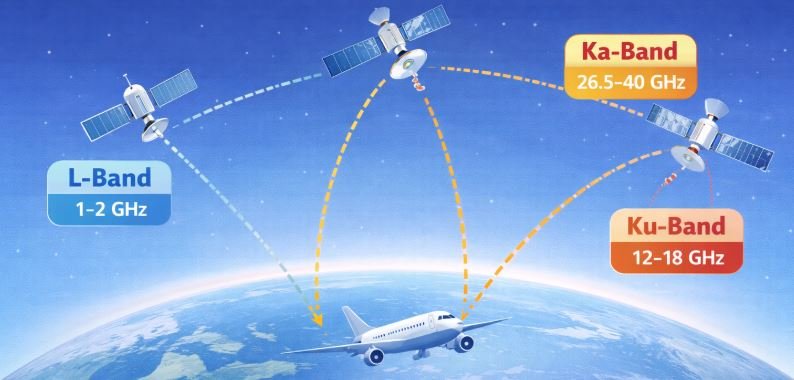
The Satellite-Based Aviation Spectrum enables global communication, navigation, and surveillance beyond the reach of terrestrial systems. It supports satellite communications (SATCOM) for voice and data, GNSS for precise positioning and navigation, and space-based ADS-B for real-time aircraft tracking over oceans and remote regions.
- L-band (1-2GHz) used by services like Inmarsat and Iridium,
- Ka band (12-18GHz) and (Ku-bands 24-40 GHz), which provide high-throughput satellite connectivity for modern aviation data requirements.
Aviation Spectrum Protection: A Safety Imperative
Protecting aviation spectrum is critical because aviation systems operate at low signal power, demand high integrity, and have zero tolerance for harmful interference. Any disruption can directly compromise flight safety and operational efficiency. Key threats include
- 5G and mobile broadband interference,
- unauthorized transmitters,
- GNSS jamming and spoofing, and
- poorly coordinated spectrum refarming.
High-profile global concerns, such as 5G C-band interference with aircraft radio altimeters and GNSS disruptions near conflict zones, highlight the importance of rigorous spectrum protection measures to ensure safe, reliable, and uninterrupted aviation operations worldwide.
Emerging Challenges in Aviation Spectrum
The aviation spectrum landscape faces increasing complexity due to technological advancements and growing air traffic. Integration with 5G and future 6G networks requires careful coexistence with terrestrial IMT systems, implementation of guard bands and power limits, and establishment of airport protection zones to prevent interference with critical aviation systems.
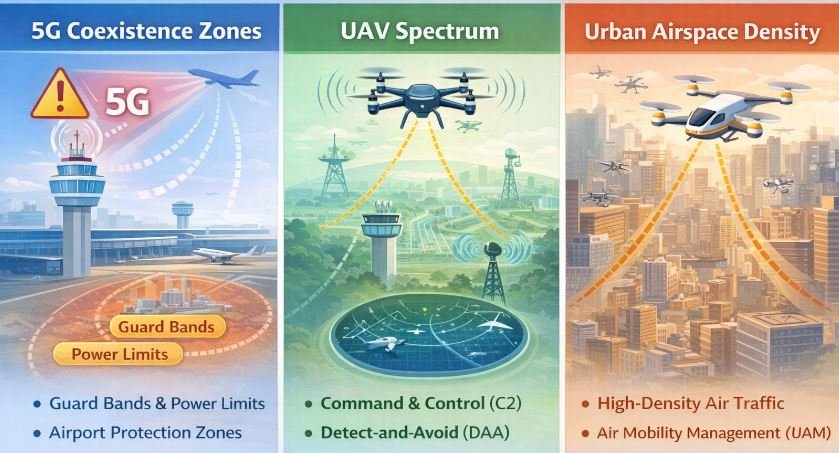
The rapid rise of UAVs (drones) and Urban Air Mobility (UAM) introduces new demands for Command and Control (C2) spectrum, Detect-and-Avoid (DAA) systems, and managing high-density airspace in urban environments.
Additionally, the increasing demand for digital aviation services—including Controller Pilot Data Link Communications (CPDLC), System Wide Information Management (SWIM), digital ATC, and real-time aircraft health monitoring—places further pressure on existing spectrum resources, necessitating innovative management and protection strategies.
Conclusion
In conclusion, the aviation frequency spectrum is the invisible lifeline of global air navigation, enabling safe, efficient, and reliable communication, navigation, and surveillance across the skies. From VHF and HF communication to GNSS, radar systems, and satellite-based ADS-B, every critical aviation function depends on carefully allocated and protected spectrum bands. With growing challenges such as 5G/6G coexistence, UAVs, urban air mobility, and increasing digital data demand, spectrum protection and effective governance have never been more vital. Global coordination through ITU, ICAO, and national authorities ensures that despite technological evolution and crowded airwaves, aviation operations remain safe, interoperable, and interference-free, safeguarding the lives of passengers and the integrity of worldwide air transport.