Aviation Phonetic Alphabet: How ATC and Pilots Communicate Clearly
“Tower, this is Flight 302 ready for departure on runway three-two… correction, runway three-zero-two—” Static fills the headset. The air traffic controller leans forward, squinting at the radar screen. “Say again, Flight 302?”
Was that a ‘B’ or a ‘D’? A ‘Three’ or a ‘Free’?
We’ve all experienced the frustration of trying to spell our name, an address, or a street over the phone, only for the other person to mishear us. “Did you say B as in boy or D as in dog?”
Now imagine that same confusion at 30,000 feet — with jet engines roaring, multiple aircraft sharing the same frequency, and critical instructions being passed every second. In aviation, a single misheard word can have serious consequences. That’s why the skies speak their own special language: the Aviation Phonetic Alphabet also known as the ICAO alphabet.
Birth of Aviation Phonetic Alphabet
Before aviation adopted a standard system, communication was often a guessing game. Each country — even each airline — had its own way of spelling things out. During World War II, the U.S., the U.K., and other allies all used slightly different “alphabets,” which caused confusion across multinational operations.
After the war, the International Civil Aviation Organization (ICAO) recognized the need for a universal phonetic alphabet that would sound distinct, clear, and unambiguous — no matter the pilot’s native language or accent.
In 1956, after extensive testing in 31 languages, ICAO finalized the alphabet we know today. It wasn’t just about letters — it was about safety, clarity, and global consistency.
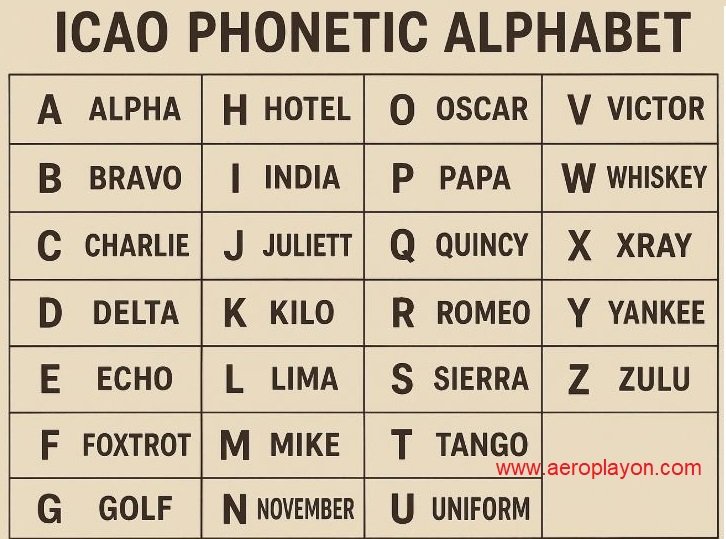
The ICAO / NATO Phonetic Alphabet (A–Z)
| Letter | Word | Pronunciation |
|---|---|---|
| A | Alpha | AL-fah |
| B | Bravo | BRAH-voh |
| C | Charlie | CHAR-lee |
| D | Delta | DELL-tah |
| E | Echo | ECK-oh |
| F | Foxtrot | FOKS-trot |
| G | Golf | GOLF |
| H | Hotel | HOH-tel |
| I | India | IN-dee-ah |
| J | Juliett | JEW-lee-ett |
| K | Kilo | KEY-loh |
| L | Lima | LEE-mah |
| M | Mike | MIKE |
| N | November | no-VEM-ber |
| O | Oscar | OSS-car |
| P | Papa | PAH-pah |
| Q | Quebec | keh-BECK |
| R | Romeo | ROW-mee-oh |
| S | Sierra | see-AIR-rah |
| T | Tango | TANG-go |
| U | Uniform | YOU-nee-form |
| V | Victor | VIK-tah |
| W | Whiskey | WISS-key |
| X | X-ray | ECKS-ray |
| Y | Yankee | YANG-key |
| Z | Zulu | ZOO-loo |
Numbers: Spoken with Precision
Just as letters can be misheard, so can numbers — especially over radio static. To avoid confusion, ICAO standardized how numbers are spoken too:
| Number | Spoken As | Example |
|---|---|---|
| 0 | Zero | Flight Level One Zero Zero |
| 1 | Wun | Heading Wun Eight Zero |
| 2 | Too | Climb to Too Thousand Feet |
| 3 | Tree | Runway Tree Six |
| 4 | Fower | Altitude Fower Thousand |
| 5 | Fife | Speed Two Fife Zero |
| 6 | Six | Turn Heading Six Zero |
| 7 | Seven | Maintain Seven Thousand |
| 8 | Ait | Contact on One Two Three Decimal Ait |
| 9 | Niner | Flight Level Two Niner Zero |
Conclusion
The next time you hear a pilot say, “Lima Charlie,” remember — it isn’t just a clever phrase. It means “Loud and Clear,” a simple confirmation that both sides understand each other perfectly.
This alphabet, standardized decades ago, continues to save lives every day. It reminds us that in aviation, communication isn’t just about speaking — it’s about being understood.
In the fast-paced world of aviation, there’s no room for doubt. A misheard altitude, or a garbled instruction can have serious consequences. That’s why, long before satellites, automation, and artificial intelligence entered the cockpit, aviators built a language of precision — one where every word was tested, refined, and agreed upon worldwide.
The Aviation Phonetic Alphabet is more than a list of words; it’s a shared code of trust. It bridges pilots and controllers who may never meet, who may not even speak the same native language, yet understand each other with perfect clarity.
From “Alpha” to “Zulu,” it’s a reminder that communication isn’t just about speaking — it’s about being understood.
And in aviation, that understanding doesn’t just make flying efficient — it keeps the skies safe for everyone beneath them.